As we age, our immune system’s robustness gradually diminishes, a phenomenon clinically linked to increased susceptibility to infections, poorer vaccine responses, and a rise in cancer incidence. A central player in this decline is the involution of the thymus, a small organ nestled near the heart. Often called the body’s "T-cell school," the thymus is essential for the production and education of naive T-cells – fresh, adaptable immune soldiers ready to face new threats. In humans and other mammals, this organ begins a significant reduction in size and functional tissue early in life, a process that drastically limits the output of new T-cells, shrinks the diversity of the T-cell receptor repertoire, and ultimately weakens primary immune responses.
Scientists have long sought strategies to halt or reverse thymic involution, experimenting with hormones, cytokines, and even the radical approach of parabiosis (surgically joining circulatory systems of young and old animals). However, these methods have shown limited efficacy or present substantial clinical hurdles. The quest for a safe and effective way to rejuvenate the aging immune system has remained a significant challenge in the field of immunology.
Scientists have long sought strategies to halt or reverse thymic involution, experimenting with hormones, cytokines, and even the radical approach of parabiosis (surgically joining circulatory systems of young and old animals). However, these methods have shown limited efficacy or present substantial clinical hurdles. The quest for a safe and effective way to rejuvenate the aging immune system has remained a significant challenge in the field of immunology.
Hijacking the Liver as a Protein Factory
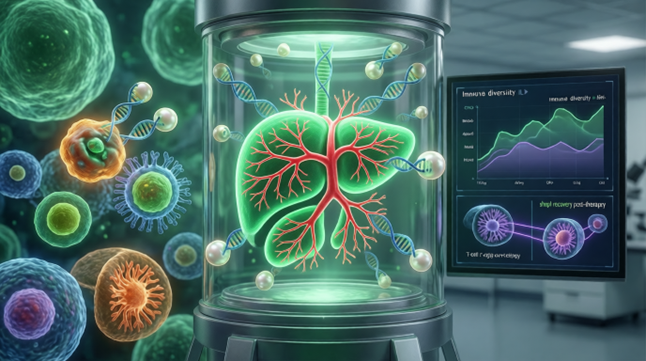
Confronted with the difficulty of directly targeting the intricate and involuted thymus, a team of researchers in the United States devised an ingenious workaround. They proposed using the liver as a temporary production site for the very factors needed to restore thymic function. The liver is an ideal target: it is highly efficient at producing and secreting proteins into the bloodstream.
The scientific foundation for their choice of factors came from a deep analysis of T-cell changes over a mouse’s lifetime. By sequencing over 97,000 T-cell transcriptomes, the team identified a critical decline in signaling pathways crucial for T-cell survival and maintenance, specifically those involving Notch, IL-7, and FLT3-L. These molecules act as essential survival and instructional signals. Based on this, they selected a trio of key immuno-supportive factors: DLL4 (a Notch pathway ligand), FLT3-L, and IL-7, collectively termed "DFI."
The scientific foundation for their choice of factors came from a deep analysis of T-cell changes over a mouse’s lifetime. By sequencing over 97,000 T-cell transcriptomes, the team identified a critical decline in signaling pathways crucial for T-cell survival and maintenance, specifically those involving Notch, IL-7, and FLT3-L. These molecules act as essential survival and instructional signals. Based on this, they selected a trio of key immuno-supportive factors: DLL4 (a Notch pathway ligand), FLT3-L, and IL-7, collectively termed "DFI."
Messenger RNA in a Lipid Shield
To deliver these factors, the team turned to messenger RNA (mRNA) technology. Instead of injecting the proteins themselves, which can cause systemic inflammation, they delivered mRNA instructions wrapped in specialized lipid nanoparticles (LNPs). When these LNPs are injected intravenously, they are predominantly taken up by liver cells. The liver cells then temporarily use the mRNA blueprints to manufacture and secrete the DFI proteins into circulation.
This method offers several advantages. Protein production is transient, lasting only as long as the stable, modified mRNA persists in the cells. The liver-specific targeting minimizes off-target effects. Crucially, in the study, this approach did not trigger the significant inflammatory cytokine release observed when using traditional recombinant proteins.
This method offers several advantages. Protein production is transient, lasting only as long as the stable, modified mRNA persists in the cells. The liver-specific targeting minimizes off-target effects. Crucially, in the study, this approach did not trigger the significant inflammatory cytokine release observed when using traditional recombinant proteins.
Restoring Youthful Function in Aged Mice
The results in elderly (72-week-old) mice were striking. A four-week regimen of DFI-mRNA-LNP treatment led to a visible rejuvenation of the thymus, increasing its mass and cellularity. This was reflected in the periphery by a rise in the number and proportion of circulating naive CD8+ T-cells – the very population depleted by aging. Importantly, the treatment did not disproportionately expand memory T-cells or exacerbate autoimmune tendencies in prone mouse models.
Functionally, this immune refresh translated into significant benefits. Aged mice treated with DFI responded much more robustly to vaccination against a model antigen (ovalbumin), generating stronger and more specific T-cell responses. Furthermore, in a cancer model where aged mice typically show poor survival and minimal benefit from checkpoint inhibitor immunotherapy (anti-PD-L1), the DFI pre-treatment revitalized the anti-tumor immune response, significantly enhancing the therapy's effectiveness.
Functionally, this immune refresh translated into significant benefits. Aged mice treated with DFI responded much more robustly to vaccination against a model antigen (ovalbumin), generating stronger and more specific T-cell responses. Furthermore, in a cancer model where aged mice typically show poor survival and minimal benefit from checkpoint inhibitor immunotherapy (anti-PD-L1), the DFI pre-treatment revitalized the anti-tumor immune response, significantly enhancing the therapy's effectiveness.
A Transient Boost with a Favorable Safety Profile
A key finding was the therapy's transient and targeted nature. The beneficial effects on immune cell populations peaked during treatment and gradually returned to baseline within four weeks after cessation. This indicates the approach provides a controllable "boost" rather than a permanent alteration. Comprehensive safety analyses showed no negative impact on liver function or body weight, and critically, no induction or worsening of autoimmune disease in predisposed models. This suggests the therapy replenishes age-related deficits without causing non-specific, potentially dangerous, immune over-activation.
Implications for the Future of Regenerative Medicine
This research demonstrates that temporarily repurposing the liver as a bio-factory for therapeutic proteins via mRNA-LNPs can systemically influence complex physiological processes, like immune aging.
The implications are broad. While directly targeting human thymic involution remains a long-term goal, this work opens a pathway for developing temporary immunorejuvenation therapies. Such interventions could be envisioned to enhance vaccine efficacy in the elderly, improve outcomes for cancer immunotherapy in older patients, or potentially help recover immune function after certain medical procedures. The platform itself – using mRNA-LNPs to instruct the liver to produce specific secretory factors – could be adapted to address other conditions where systemic but controlled delivery of therapeutic proteins is needed, marking a significant step forward in the toolkit of regenerative and precision medicine.
The implications are broad. While directly targeting human thymic involution remains a long-term goal, this work opens a pathway for developing temporary immunorejuvenation therapies. Such interventions could be envisioned to enhance vaccine efficacy in the elderly, improve outcomes for cancer immunotherapy in older patients, or potentially help recover immune function after certain medical procedures. The platform itself – using mRNA-LNPs to instruct the liver to produce specific secretory factors – could be adapted to address other conditions where systemic but controlled delivery of therapeutic proteins is needed, marking a significant step forward in the toolkit of regenerative and precision medicine.
Publication date: 2026.01.30
Source:
Friedrich M.J. et al. Transient hepatic reconstitution of trophic factors enhances aged immunity. Nature. 2025 Dec 17. doi: 10.1038/s41586-025-09873-4. Epub ahead of print. PMID: 41407851.
https://www.nature.com/articles/s41586-025-09873-4