The Longevity Paradox
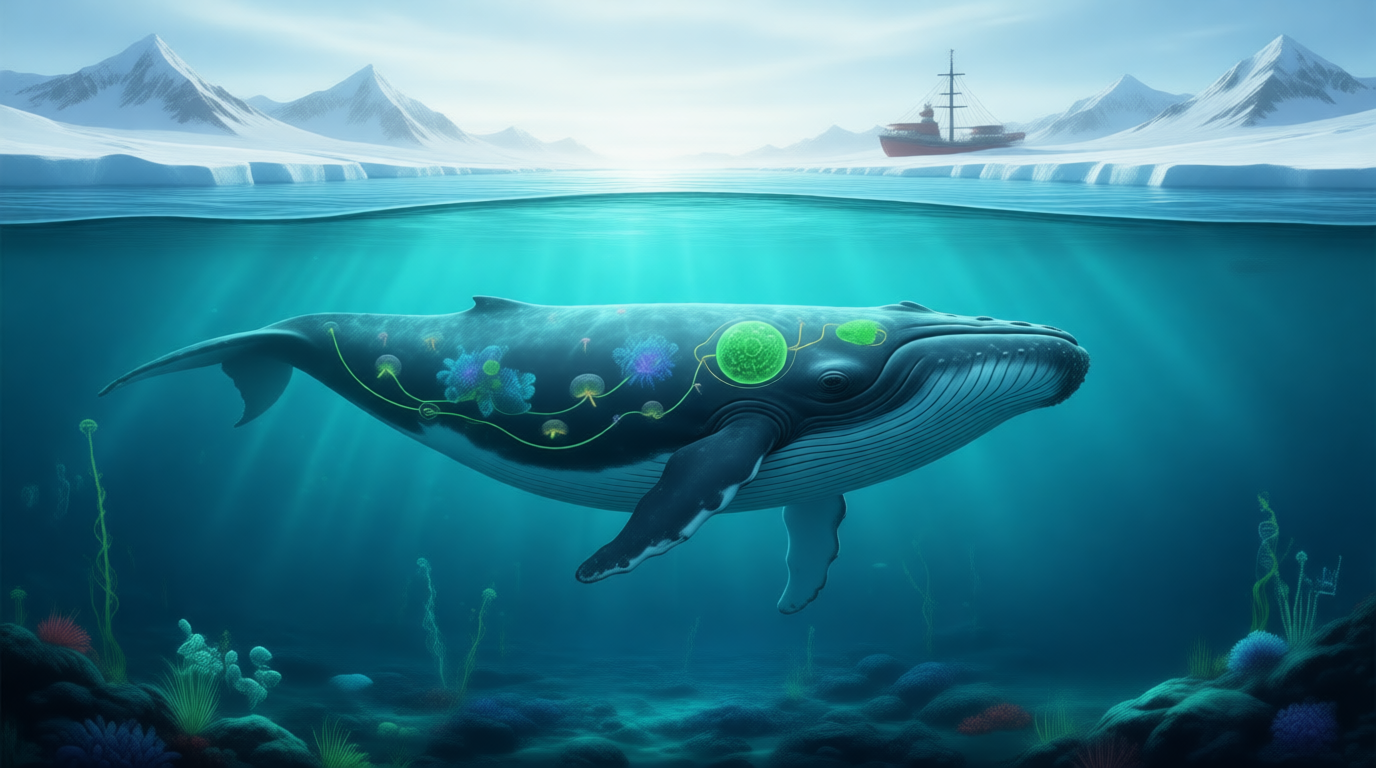
Greenland whales (Balaena mysticetus) are true record-holders among mammals. Some individuals reach weights exceeding 80 metric tons and live for over 200 years—measurements that present science with a puzzle known as Peto's paradox. According to theory, increased cell number and extended lifespan should multiplicatively elevate cancer risk. However, in nature, we frequently observe the opposite: large and long-lived species generally exhibit lower cancer risk than their smaller, shorter-lived counterparts. Researchers from the University of Rochester and Harvard Medical School have uncovered one mechanism that enables Greenland whales to avoid cancer despite their size and longevity.
An Alternative Pathway of Oncoprotection
For a long time, scientists hypothesized that large animals, such as elephants, protect themselves from cancer through enhanced activity of tumor suppressors like p53. However, in Greenland whales, this mechanism operates differently. By comparing fibroblasts from whales, humans, and mice, researchers discovered that whales do not exhibit elevated expression of p53 or other classical tumor suppressors. Moreover, the number of mutations required to initiate oncogenesis in whales was found to be even lower than in humans.
Surprisingly, detailed genomic analysis revealed that Greenland whales possess significantly fewer de novo single nucleotide variants (SNVs), small indels, and large structural rearrangements compared to other species. This indicated the existence of more efficient mechanisms for maintaining genomic integrity, which became the focus of further investigation.
Surprisingly, detailed genomic analysis revealed that Greenland whales possess significantly fewer de novo single nucleotide variants (SNVs), small indels, and large structural rearrangements compared to other species. This indicated the existence of more efficient mechanisms for maintaining genomic integrity, which became the focus of further investigation.
CIRBP: Key Player in DNA Repair
Scientists primarily focused on two major mechanisms of double-strand DNA break repair: homologous recombination (HR) and non-homologous end joining (NHEJ). It was found that both processes operate significantly more efficiently in whales than in humans or mice. Particularly noteworthy was the observation that NHEJ in whales, despite its inherently mutagenic nature, results in substantially fewer deletions – the most common type of error in this repair mechanism.
Through transcriptomic analysis and mass spectrometry, researchers identified that the cold-inducible RNA-binding protein (CIRBP) plays a crucial role in this process. Greenland whales exhibit significantly higher expression levels of CIRBP compared to other studied mammals (with the exception of humpback whales and certain dolphin species). Notably, replacing just five C-terminal amino acids in human CIRBP with whale analogs increased protein stability, though not to the level observed in whales, potentially indicating the role of synonymous substitutions in translational regulation.
Through transcriptomic analysis and mass spectrometry, researchers identified that the cold-inducible RNA-binding protein (CIRBP) plays a crucial role in this process. Greenland whales exhibit significantly higher expression levels of CIRBP compared to other studied mammals (with the exception of humpback whales and certain dolphin species). Notably, replacing just five C-terminal amino acids in human CIRBP with whale analogs increased protein stability, though not to the level observed in whales, potentially indicating the role of synonymous substitutions in translational regulation.
From Cell Cultures to Living Organisms
To confirm their hypothesis, researchers conducted a series of experiments. First, they artificially expressed whale CIRBP in human fibroblasts and discovered that it significantly enhanced the efficiency of both HR and NHEJ. Furthermore, in mutant cell lines prone to oncogenesis, whale CIRBP expression slowed the development of tumorigenic features. The opposite effect was observed when CIRBP was deleted from whale fibroblasts.
A critical stage of the research involved in vivo testing on Drosophila. Overexpression of both human and whale CIRBP in these insects led to a significant increase in lifespan and enhanced survival following exposure to ionizing radiation. This confirms the evolutionary conservation of CIRBP's function in genomic protection.
A critical stage of the research involved in vivo testing on Drosophila. Overexpression of both human and whale CIRBP in these insects led to a significant increase in lifespan and enhanced survival following exposure to ionizing radiation. This confirms the evolutionary conservation of CIRBP's function in genomic protection.
Medical Implications
The discovery of CIRBP's role in maintaining genomic stability opens new horizons for oncology and gerontology. Unlike traditional approaches focused on enhancing apoptosis or inhibiting proliferation, modulation of CIRBP activity could strengthen natural DNA repair mechanisms – particularly important for patients with hereditary syndromes associated with DNA repair defects.
Notably, CIRBP is already known for its role in cellular stress response, including hypoxia and hypothermia, which may explain whales' adaptation to life in polar waters. Its ability to bind DNA at break sites opens possibilities for developing therapies aimed at enhancing DNA repair accuracy in humans.
This research reminds us that nature has already developed solutions to problems facing modern medicine. By studying adaptations of extreme species, we can find keys to extending healthy human lifespan and combating diseases such as cancer. Greenland whales, these titans of the ocean, may prove to be unexpected allies in our quest for healthy longevity.
Notably, CIRBP is already known for its role in cellular stress response, including hypoxia and hypothermia, which may explain whales' adaptation to life in polar waters. Its ability to bind DNA at break sites opens possibilities for developing therapies aimed at enhancing DNA repair accuracy in humans.
This research reminds us that nature has already developed solutions to problems facing modern medicine. By studying adaptations of extreme species, we can find keys to extending healthy human lifespan and combating diseases such as cancer. Greenland whales, these titans of the ocean, may prove to be unexpected allies in our quest for healthy longevity.
Publication date: 05.11.2025
Source:
Firsanov D. et al. Evidence for improved DNA repair in long-lived bowhead whale. Nature. 2025 Oct 29. doi: 10.1038/s41586-025-09694-5. Epub ahead of print. PMID: 41162698.
https://www.nature.com/articles/s41586-025-09694-5
Source:
Firsanov D. et al. Evidence for improved DNA repair in long-lived bowhead whale. Nature. 2025 Oct 29. doi: 10.1038/s41586-025-09694-5. Epub ahead of print. PMID: 41162698.
https://www.nature.com/articles/s41586-025-09694-5