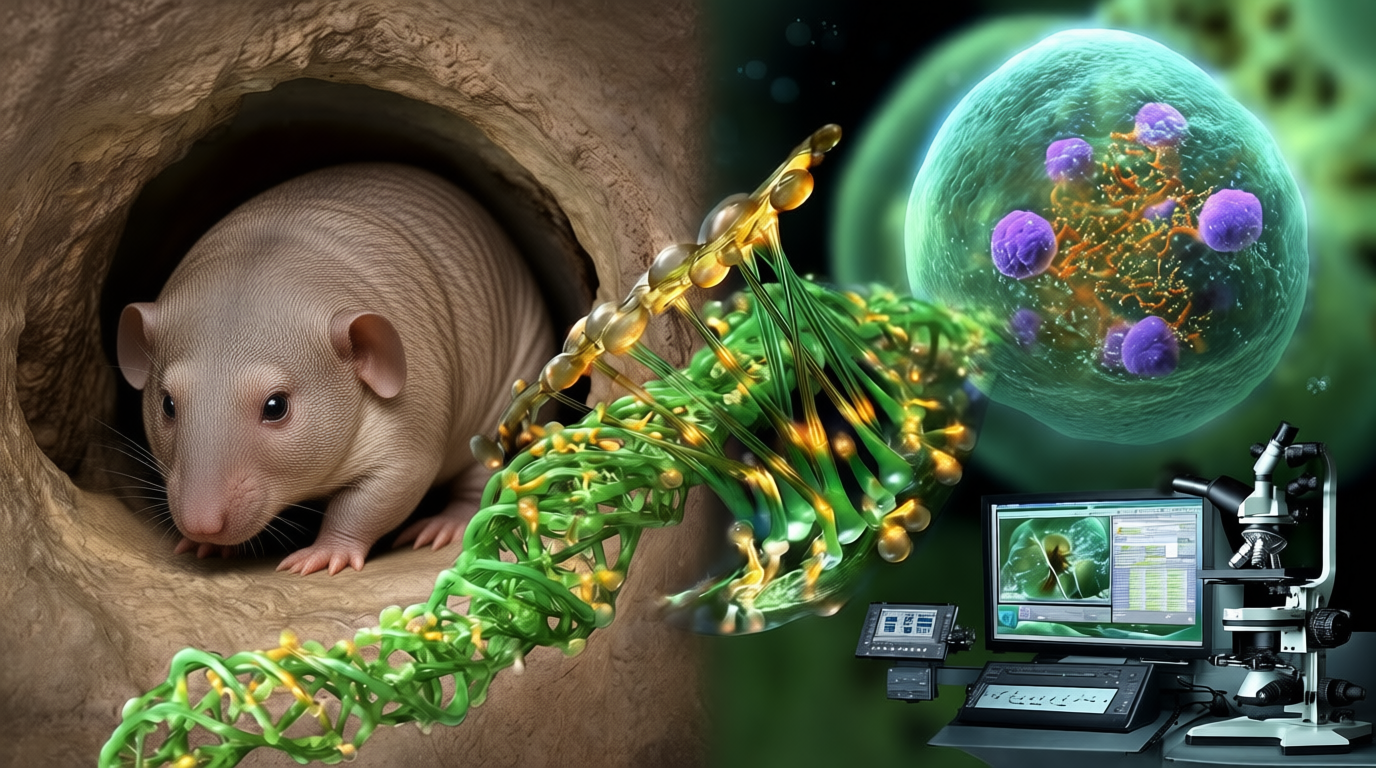
Chinese researchers have discovered that in the naked mole-rat (nature’s longest-lived rodent) the enzyme cyclic GMP-AMP synthase (cGAS) has evolved a unique function: rather than suppressing DNA repair, it actively promotes homologous recombination (HR), thereby accelerating the repair of DNA double-strand breaks. Four specific amino acid substitutions in its structure fundamentally alter its chromatin-binding dynamics and confer anti-aging effects in model organisms.
From Immune Sensor to DNA Repair Regulator
cGAS is classically recognized as a cytosolic DNA sensor that activates the type I interferon response via the cGAS-STING pathway upon detection of foreign or misplaced DNA. However, recent studies have shown that nuclear cGAS in mammalian cells binds chromatin and inhibits homologous recombination – the primary high-fidelity pathway for repairing DNA double-strand breaks. This inhibitory role is thought to arise from competitive displacement of key repair factors, potentially contributing to genomic instability and tumorigenesis.
In stark contrast, cGAS from the naked mole-rat (Heterocephalus glaber), which lives up to 30 years (ten times longer than other rodents) enhances HR rather than suppressing it. This finding challenges the prevailing view of cGAS as solely a pro-inflammatory and potentially pro-aging factor.
In stark contrast, cGAS from the naked mole-rat (Heterocephalus glaber), which lives up to 30 years (ten times longer than other rodents) enhances HR rather than suppressing it. This finding challenges the prevailing view of cGAS as solely a pro-inflammatory and potentially pro-aging factor.
Four Substitutions Flip the Functional Switch
Comparative sequence analysis revealed that this functional inversion hinges on just four amino acid substitutions: S463, E511, Y527, and T530 in the naked mole-rat versus D463, K511, L527, and K530 in humans. These residues locate in the C-terminal domain and do not affect the catalytic site; notably, even catalytically inactive mutants retained the ability to modulate HR, indicating a non-enzymatic, structural role in DNA repair regulation.
The critical mechanism involves prolonged chromatin association. Following DNA damage, naked mole-rat cGAS exhibits markedly reduced ubiquitination, leading to delayed proteasomal degradation and sustained chromatin binding. This extended residence enables cGAS to recruit RAD50 (a core component of the MRN complex) and FANCI, a protein not previously implicated in HR-mediated double-strand break repair.
Conversely, human cGAS rapidly dissociates from chromatin in a P97 (VCP) AAA+ ATPase-dependent manner, acting as a steric blocker that impedes access of repair complexes to break sites. Pharmacological inhibition of P97 partially rescues HR efficiency, supporting this competitive interference model.
The critical mechanism involves prolonged chromatin association. Following DNA damage, naked mole-rat cGAS exhibits markedly reduced ubiquitination, leading to delayed proteasomal degradation and sustained chromatin binding. This extended residence enables cGAS to recruit RAD50 (a core component of the MRN complex) and FANCI, a protein not previously implicated in HR-mediated double-strand break repair.
Conversely, human cGAS rapidly dissociates from chromatin in a P97 (VCP) AAA+ ATPase-dependent manner, acting as a steric blocker that impedes access of repair complexes to break sites. Pharmacological inhibition of P97 partially rescues HR efficiency, supporting this competitive interference model.
Anti-Aging Effects In Vivo: From Flies to Mice
Functional validation across species confirmed the physiological relevance of this mechanism. In human cells, introduction of the four “mole-rat” residues enhanced resistance to ionizing radiation, reduced markers of stress-induced premature senescence, and suppressed oncogene-driven cellular transformation.
Transgenic Drosophila expressing naked mole-rat cGAS exhibited delayed aging phenotypes: improved gut barrier integrity, reduced chronic immune activation (“inflammaging”), and sustained locomotor function. Median lifespan increased by 10–15%, a substantial gain in a species with a two-month lifespan.
In aging mice, delivery of an adeno-associated virus (AAV) encoding naked mole-rat cGAS significantly attenuated age-related decline: hair graying was delayed, and plasma levels of interleukin-6 and immunoglobulin G (established biomarkers of inflammatory aging) were markedly reduced. These results demonstrate that enhancing DNA repair via cGAS modulation can systemically slow physiological aging.
Transgenic Drosophila expressing naked mole-rat cGAS exhibited delayed aging phenotypes: improved gut barrier integrity, reduced chronic immune activation (“inflammaging”), and sustained locomotor function. Median lifespan increased by 10–15%, a substantial gain in a species with a two-month lifespan.
In aging mice, delivery of an adeno-associated virus (AAV) encoding naked mole-rat cGAS significantly attenuated age-related decline: hair graying was delayed, and plasma levels of interleukin-6 and immunoglobulin G (established biomarkers of inflammatory aging) were markedly reduced. These results demonstrate that enhancing DNA repair via cGAS modulation can systemically slow physiological aging.
Implications for Gerontology
This work underscores that repair fidelity is a decisive determinant of longevity. The naked mole-rat’s evolutionary solution was not to exclude cGAS from the nucleus, but to “reprogram” it into a pro-repair factor–a paradigm shift with profound therapeutic potential.
In the long term, this finding opens avenues for developing peptide mimetics or small-molecule modulators that emulate the mole-rat cGAS substitutions in humans, thereby prolonging chromatin retention and boosting HR. Such strategies could form the basis of novel interventions aimed at preventing age-related diseases and extending healthspan.
In the long term, this finding opens avenues for developing peptide mimetics or small-molecule modulators that emulate the mole-rat cGAS substitutions in humans, thereby prolonging chromatin retention and boosting HR. Such strategies could form the basis of novel interventions aimed at preventing age-related diseases and extending healthspan.
Publication date: 19.11.2025
Source:
Chen Y. et al A cGAS-mediated mechanism in naked mole-rats potentiates DNA repair and delays aging. Science. 2025 Oct 9;390(6769):eadp5056. doi: 10.1126/science.adp5056. Epub 2025 Oct 9. PMID: 41066557.
https://www.science.org/doi/10.1126/science.adp5056
Source:
Chen Y. et al A cGAS-mediated mechanism in naked mole-rats potentiates DNA repair and delays aging. Science. 2025 Oct 9;390(6769):eadp5056. doi: 10.1126/science.adp5056. Epub 2025 Oct 9. PMID: 41066557.
https://www.science.org/doi/10.1126/science.adp5056